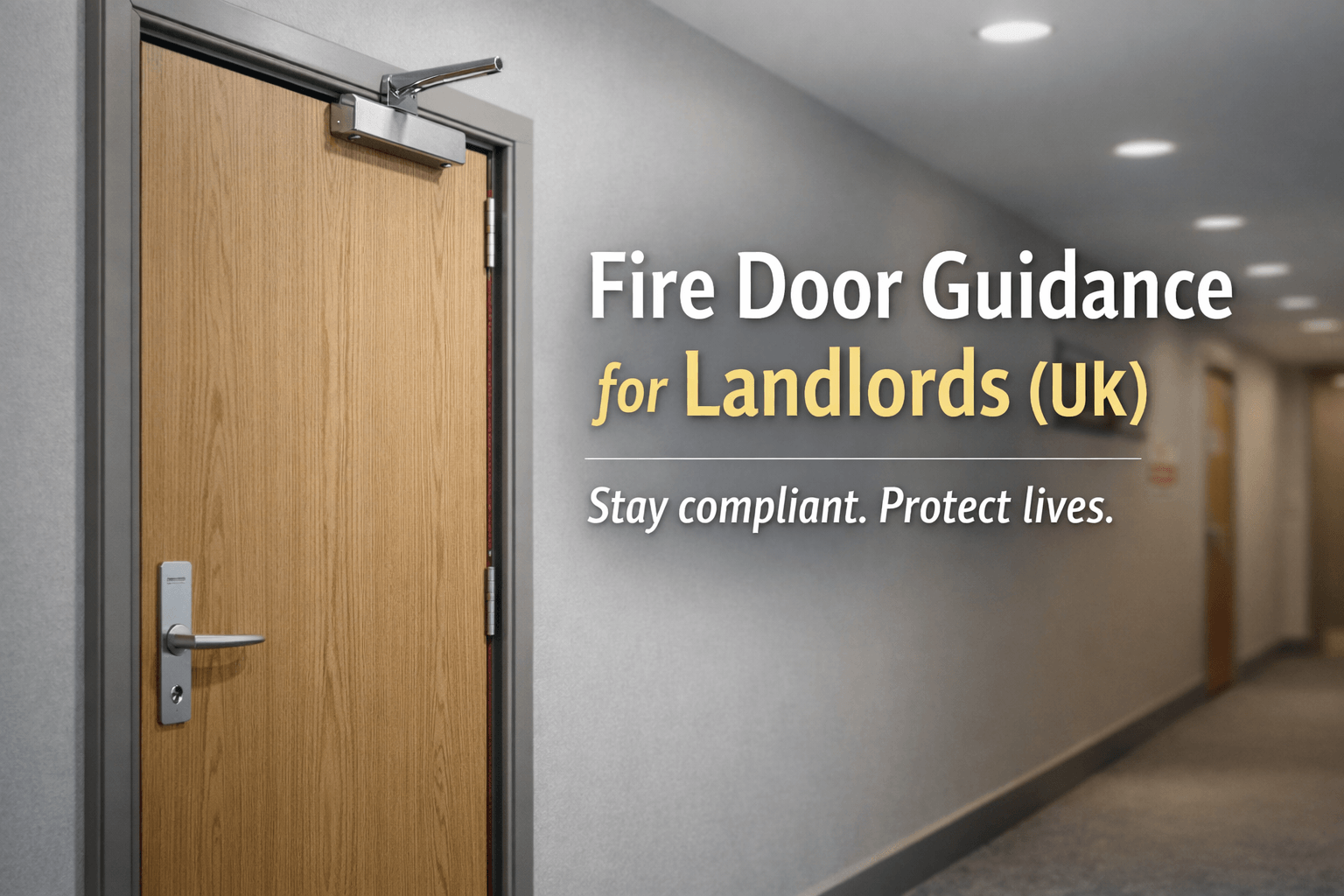
Fire Door Guidance for Landlords (UK): Legal Duties, Checks and Best Practice
Fire doors are one of the most important safety features in any residential property, yet they are often overlooked until something goes wrong. In the event of a fire, a properly functioning fire door can slow the spread of flames and smoke, protecting escape routes and giving people vital time to get out safely.
For landlords, fire door safety is not just good practice, it's a legal responsibility. Failing to meet these requirements can put tenants at serious risk and may lead to enforcement action, fines, or worse.
This guide explains what fire doors are, where they are required, and what you need to do to stay compliant in the UK.
What Is a Fire Door?
A fire door is a specially designed door that helps prevent the spread of fire and smoke for a set period of time—typically 30 minutes (FD30) or 60 minutes (FD60). This protection is critical for maintaining safe escape routes and limiting damage within a building.
However, a fire door is not just the door itself. It works as a complete system made up of several components, including the door leaf, frame, hinges, seals, and a self-closing device. If any of these parts are damaged, missing, or incorrectly fitted, the door may not perform as intended in a fire.
Legal Responsibilities for Landlords
Fire door safety in the UK is covered by several key pieces of legislation, including the Regulatory Reform (Fire Safety) Order 2005, the Fire Safety (England) Regulations 2022, and the Housing Act 2004.
As a landlord or responsible person, you are expected to ensure that fire doors are installed where required and kept in safe working condition. This includes carrying out regular checks, addressing any faults promptly, and providing relevant information to tenants where necessary.
If you manage a multi-occupied building, such as an HMO or a block of flats, your responsibilities are more extensive and require a more structured approach to inspection and maintenance.
Where Are Fire Doors Required?
Fire doors are typically required in properties where there is a need to prevent fire and smoke spreading between different areas. This commonly includes HMOs, flats, and buildings with shared corridors or stairwells.
They are also often required between a main property and an integral garage, as well as in higher-risk areas such as kitchens or boiler rooms.
The exact requirements will depend on the layout and use of the building, so it is important to refer to a suitable fire risk assessment or guidance from your local authority.
Fire Door Inspection: What Should You Check?
Regular inspections are essential to ensure fire doors remain effective. While detailed inspections should be carried out by a competent professional, landlords can carry out basic checks to identify obvious issues.
When checking a fire door, start by looking at its overall condition. The door should be free from visible damage such as cracks, warping, or holes, and it should close properly into the frame without resistance.
The self-closing mechanism is another key feature. A fire door should close fully on its own without sticking or needing to be pushed. If it does not fully close, it may not provide adequate protection.
You should also check the gaps around the door. These should generally be around 2–4mm, which is roughly the thickness of a pound coin. Intumescent strips should be intact and must not be painted over, and smoke seals should be present where required.
Hinges should be secure, with at least three fitted, and in good condition. Finally, look for a certification label or plug, which confirms the fire rating of the door.
How Often Should Fire Doors Be Checked?
Under the Fire Safety (England) Regulations 2022, fire doors in communal areas should be checked at least every three months. Flat entrance doors should be checked at least once a year.
Carrying out these checks regularly helps ensure that any issues are identified early and dealt with before they become serious risks.
Common Mistakes Landlords Must Avoid
Many fire door issues are caused by simple but critical mistakes. For example, wedging fire doors open or removing self-closing devices can completely undermine their purpose.
Painting over seals or hinges, using non-compliant replacement parts, or ignoring reported faults can also prevent a fire door from working correctly. These issues are often easy to avoid with proper awareness and routine checks.
Tenant Awareness
Fire door safety is not just the landlord’s responsibility, tenants also play an important role in maintaining a safe environment.
Tenants should understand that fire doors are designed to protect them and should be kept closed whenever possible. They should also avoid tampering with self-closing devices and report any faults as soon as they are noticed.
Clear communication between landlords and tenants can make a significant difference in overall fire safety.
Maintenance and Certification
To ensure reliability and compliance, fire doors should always be installed and maintained by competent professionals.
Using certified fire doorsets and qualified installers, particularly those accredited by recognised third-party schemes such as Certifire or BM TRADA—helps ensure that the door will perform as expected in the event of a fire.
Consequences of Non-Compliance
Failing to meet fire door requirements can have serious consequences. Landlords may face fines, legal action, or invalidated insurance policies if they are found to be non-compliant.
More importantly, the risk to life increases significantly when fire doors are not properly maintained. In many cases, fire doors are the difference between safe escape and a potentially tragic outcome.
Final Thoughts
Fire doors are not simply a regulatory requirement, they are a vital part of your property’s life safety system.
By carrying out regular checks, maintaining doors correctly, and ensuring tenants understand their importance, landlords can significantly reduce risk and stay compliant with UK regulations.
📞 Need Help with Fire Door Compliance?
Managing fire door safety across one or multiple properties can quickly become complex, especially as regulations continue to evolve.
At Ironleaf Safety Strategies, we provide straightforward, professional fire door inspections tailored to landlords, property managers, and commercial environments.
Our service includes detailed condition checks, clear reporting, and practical recommendations, helping you stay compliant without unnecessary complexity.
If you’d like support or advice, get in touch to see how we can help.